The Breed
Anatolian Shepherd vs Kangal: what's the difference?
They come from the same Turkish livestock guardian dogs. Whether they count as one breed or two depends on which kennel club you ask. The American Kennel Club registers them all as Anatolian Shepherd Dogs. The United Kennel Club and the international FCI treat the Kangal as its own breed with a narrower standard. In the United States, a dog can move from one name to the other on paperwork.
Are the Anatolian Shepherd and the Kangal the same breed?
Both names describe the big guardian dogs that Turkish shepherds have used for centuries. ‘Kangal’ comes from the Kangal district of Sivas province. ‘Anatolian Shepherd’ is the name used in the United States for Turkish guardian dogs as a whole.
Until 2018 the FCI listed its breed number 331 as the Anatolian Shepherd Dog. In June 2018, at the request of the Turkish kennel club, it renamed that breed the Kangal Shepherd Dog and published a tighter standard.
The Kangal is best understood as the narrow end of a wider type. A Kangal fits inside the Anatolian standard. Not every Anatolian fits the Kangal standard.
Can a Kangal be registered as an Anatolian Shepherd?
Yes, with conditions. The Anatolian Shepherd Dog Club of America, the AKC parent club, says a Kangal registered with the United Kennel Club or the Kangal Dog Club of America can be registered as an Anatolian Shepherd Dog if the owner gives up the Kangal registration and the dog meets the Anatolian standard. The club’s written registration policy on Kangals took effect February 1, 2014, and it does not support holding both registrations at once. A dog that still has Kangal-registered ancestors in its three-generation pedigree is not accepted. The club’s by-laws state that dogs commonly called Kangal, Akbash or Karabash are considered Anatolian Shepherd Dogs.
It works in the other direction too. The Kangal Dog Club of America can approve offspring of purebred Kangals that were registered as Anatolians for UKC Kangal registration.
So the same dog can be an Anatolian or a Kangal depending on which registry holds its papers.
What does the genetic research say?
Two published studies tested dogs in Turkey. A 2005 study using 100 DNA markers concluded that Kangals are genetically distinct and deserve to be identified as a breed. A 2013 study found that Kangal and Akbash dogs are different populations and that lumping every Turkish shepherd dog into one breed is incorrect.
Two cautions. First, in the 2005 study only 12 of the 23 dogs sampled as Kangals grouped as pure Kangals. The other 11 grouped with feral dogs, which shows how many Kangal-looking dogs in Turkey are crosses. Second, both studies compared dogs inside Turkey. The 2005 study set Kangals against Akbash dogs, Turkish greyhounds and feral dogs. The 2013 study covered Kangal, Akbash, Kars and Turkish Greyhound dogs. Neither tested American Anatolian Shepherds. They show that a Kangal is not an Akbash. They do not show that a Kangal differs from an Anatolian bred from the same Kangal-type imports.
Anatolian Shepherd vs Kangal side by side
| Anatolian Shepherd | Kangal | |
|---|---|---|
| Recognized by | AKC, UKC | UKC, FCI, UK Kennel Club (not AKC) |
| Male height | 29 inches and up (AKC) | 29 to 33 inches (UKC); 28.3 to 30.7 inches (FCI) |
| Male weight | 110 to 150 lb (AKC) | 110 to 145 lb (UKC); 106 to 132 lb (FCI) |
| Female height | 27 inches and up (AKC) | 27 to 31 inches (UKC); 25.6 to 28.7 inches (FCI) |
| Female weight | 80 to 120 lb (AKC) | 90 to 130 lb (UKC); 88 to 110 lb (FCI) |
| Colors | All colors and patterns | Fawn to gray with a black mask only |
| Breeding pool | Broader | Narrower |
We found no reliable evidence that the two differ in temperament, barking or weather tolerance. They are the same working type.
Which is bigger, an Anatolian or a Kangal?
Neither, on paper. The standards overlap almost completely. The AKC Anatolian standard sets minimum heights with no upper limit. The UKC Kangal standard lists a range of 29 to 33 inches for males and allows dogs to exceed it. Only the FCI Kangal standard sets a firm ceiling. The idea that Kangals are larger and more intimidating does not hold up against the numbers. Our own male, Tucker, stands 33 inches and weighs 130 pounds. That is the top of the UKC Kangal range and above the FCI range.
Why are so many different-looking dogs called Kangals?
Because the name sells. Turkey has several guardian types, including the Akbash, the Kars, the Boz and the heavier Malakli, and crosses among them are common. Many dogs sold abroad as Kangals are crosses or simply fawn dogs with black masks. Neither standard wants a mastiff head. The AKC Anatolian standard calls for flews that are normally dry, and the UKC Kangal standard faults mastiff-like flews. Heavy, hanging lips and loose skin usually point to a mastiff-type cross rather than to either breed. Papers you can verify matter more than the name in the advertisement.
What are our dogs?
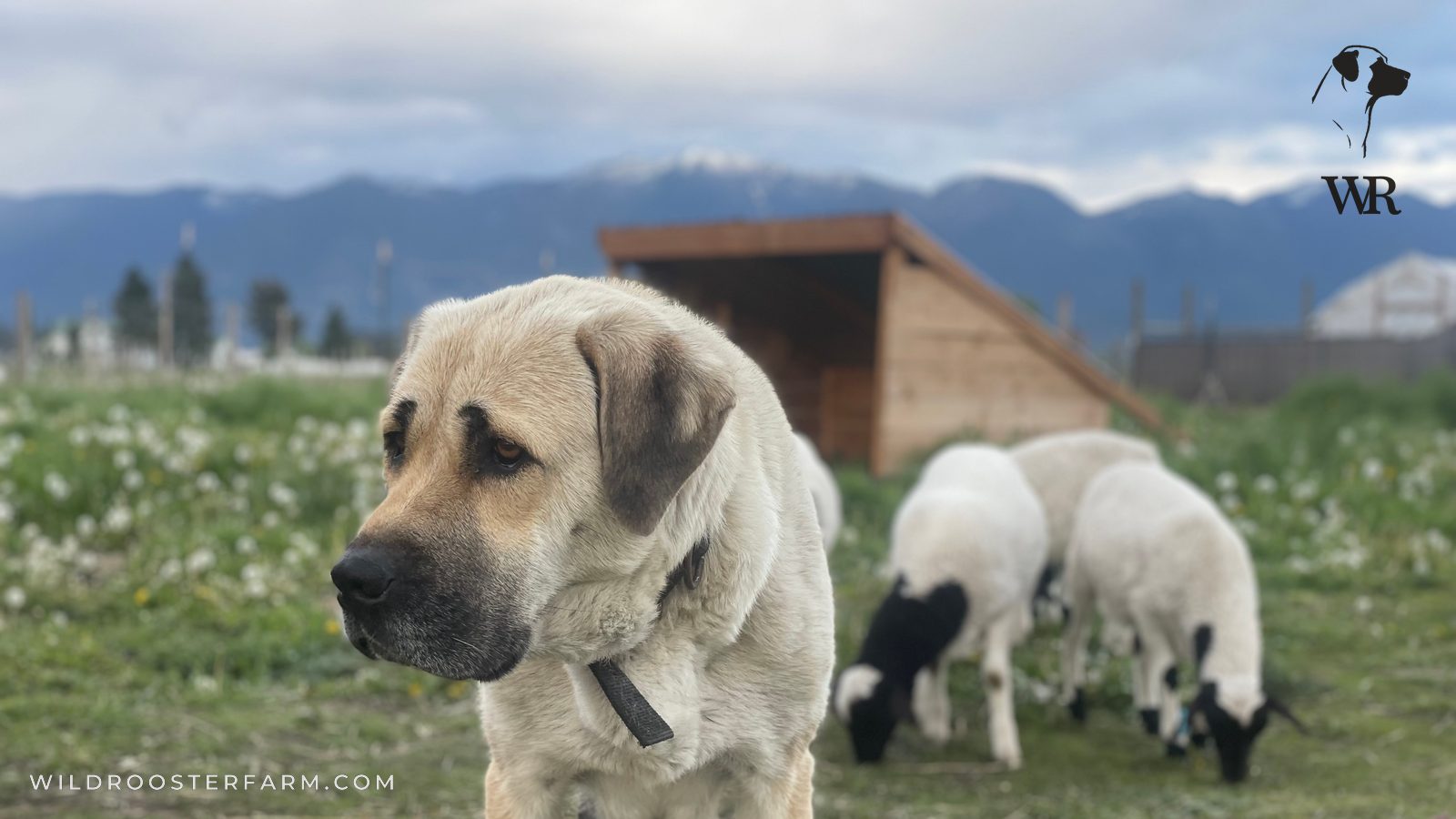
Our dogs are AKC registered Anatolian Shepherd Dogs. They sit at the Kangal end of the Anatolian type: fawn with black masks, short coats and the same working build. They come from Turkish import lines and American lines proven in both the show ring and the pasture. Their pedigrees and health results are on each dog’s profile.
How we think about the gene pool
A narrow standard and a short list of breeders make for a small gene pool. Registered Kangals outside Turkey come from a limited number of imports, and Turkey restricts exports. In a pool that small, a line can vanish because one breeder retires, two breeders fall out, or a fashion takes hold. The Anatolian registry is broader, which gives a breeder more room to work.
More room is not the same as mixing everything. Breeding unrelated dogs brings vigor and guards against inherited problems. Breeding within a proven line brings consistency: you know what the puppies will look like and how they will work. Push either one too far and you lose something. Breed too close and health suffers. Mix too many lines and you get brown paint, dogs with no clear type at all.
Our goal is to hold both. We are building toward a consistent type, the working dog at the Kangal end of the Anatolian range, and choosing each pairing so that unrelated blood keeps that type healthy.
Which is the better livestock guardian, and which should you choose?
The name on the registration does not guard sheep. What matters is whether the parents work, how the puppy is raised, and whether the dog fits your land and animals. Choose the dog, not the label. Look for health-tested parents that work livestock, a breeder who will show you both, and registration papers you can verify.
The information on this page is general information about the breed, drawn from the sources listed and from our own experience. Individual dogs vary. Nothing here is a guarantee about the health, size, temperament or working ability of any particular puppy. The terms of any sale are those in our written contract.
Sources
- AKC Anatolian Shepherd Dog
- UKC Kangal Dog breed standard
- FCI Kangal Shepherd Dog, standard number 331
- ASDCA registration information
- ASDCA by-laws
- Kangal Dog Club of America, importation and registration
- Altunok et al. 2005, “Genetic evidence for the distinctness of Kangal dogs,” Bulletin of the Veterinary Institute in Pulawy 49
- Erdogan et al. 2013, “Genetic variability among native dog breeds in Turkey,” Turkish Journal of Biology 37
- ASDCA registration policy document
- Turkish kennel club (KIF) letter published by the FCI, July 2018
- Dogs Australia, “The future of the Anatolian Shepherd Dog in Australia”
- Altunok et al. 2005, study abstract
- UK Kennel Club, Turkish Kangal Dog standard
- UKC Anatolian Shepherd standard