The Breed
Anatolian Shepherd vs Great Pyrenees: which guardian is right for you?
The Great Pyrenees is the proven, easier guardian for ordinary coyote pressure. The Anatolian Shepherd is more dog: bigger, more territorial and more aggressive toward other canines, bred in country with wolves, short-coated, and harder to own. Which one is right depends on your predators, your climate and how much dog you are ready to manage. We raise Anatolians and have never worked Pyrenees, so the Pyrenees side of this page comes from breed standards and published research.
How do the two breeds differ?
The Great Pyrenees comes from the mountains between France and Spain. The Anatolian comes from Turkey. Both were bred to live with a flock and make their own decisions.
The best side by side comparison is a survey published in 1988 of 399 producers in the United States and Canada covering 763 guardian dogs. No breed was rated more highly overall. The figures in the table below come from that survey as summarized by Ontario’s agriculture ministry. They are producer ratings, not behavior tests, and the survey had 437 Great Pyrenees but only 56 Anatolians, so the Anatolian figures are less certain.
Read plainly, the survey says the Pyrenees is the gentler dog, with people, with other dogs and with young stock, and the Anatolian is the more aggressive one toward other canines.
Which is the more capable guardian?
Against coyotes, both do the job. Producers rated 71 percent of Great Pyrenees and 77 percent of Anatolians very effective.
Harder predators are a different question. When wolves and grizzly bears returned to the northern Rockies, USDA’s Wildlife Services reported that the standard American guardian breeds, the Great Pyrenees among them, were losing fights with them and ‘are no match for these larger predators.’ Its researchers went looking for tougher dogs. They tested Kangals, some imported from Turkey and some bought from US breeders, along with two other European breeds, on working sheep ranches in Idaho, Montana, Oregon and Wyoming.
The results, published in 2019, favored the imports. Replacing one of the ranches’ mixed white guardian dogs with a Kangal cut the overall risk of losing a sheep by about 60 percent, with fewer losses to coyotes, black bears and cougars. A second model in the same paper found no significant overall effect.
Three cautions. The study did not show an advantage against wolves or grizzly bears. The dogs were Kangals, some imported from Turkey and some bought from US breeders, not American Anatolian Shepherds. And the comparison dogs were mixed white ranch dogs, not purebred Great Pyrenees.
Ranchers who work in wolf country, such as Wyoming’s Cat Urbigkit, recommend breeds that are aggressive toward other canines, because a guardian has to confront a wolf or a stray dog instead of watching it. That is the trait where the Anatolian and the Pyrenees differ most in the survey.
What does each one do when a predator shows up?
A common belief is that a Great Pyrenees hangs back with the flock while an Anatolian or Kangal goes out to meet the threat. The research supports half of that.
On where the dog stays, it does not hold. USDA researchers put GPS collars on 64 working guardian dogs and their sheep in the northern Rockies. Kangals and the mixed white ranch dogs kept about the same distance from their sheep, and no breed stayed closer or ranged farther by a margin the numbers could confirm.
On how the dog responds, it does. When the same researchers set out a wolf decoy and played a howl, Kangals were about eight times more likely than the white ranch dogs to go in and investigate it during the first minute. The authors read that as a greater willingness to engage physically. The UKC Kangal standard describes the same trait: a dog bred ‘to intercept and confront threats.’
So the difference is less about where the dog stands and more about how readily it closes with a threat. The white dogs in these studies were mixed ranch dogs, not purebred Great Pyrenees.
How do they compare in size and presence?
On paper the two overlap in height. The Great Pyrenees standard runs 27 to 32 inches for males and says a 27-inch male weighs about 100 pounds. The Anatolian standard starts at 29 inches and 110 pounds for males, runs to 150 pounds, and sets no upper height. The AKC standard describes the Anatolian as ‘large, rugged, powerful and impressive.’
A short coat hides nothing. What you see on an Anatolian is bone, chest and muscle.
Our own dogs, measured: Tucker stands 33 inches and weighs 130 pounds. Bailey stands 29 inches and weighs about 100 pounds. Their daughter Smokie stands 31 inches and weighs 110 pounds.
Short coat or long white coat?
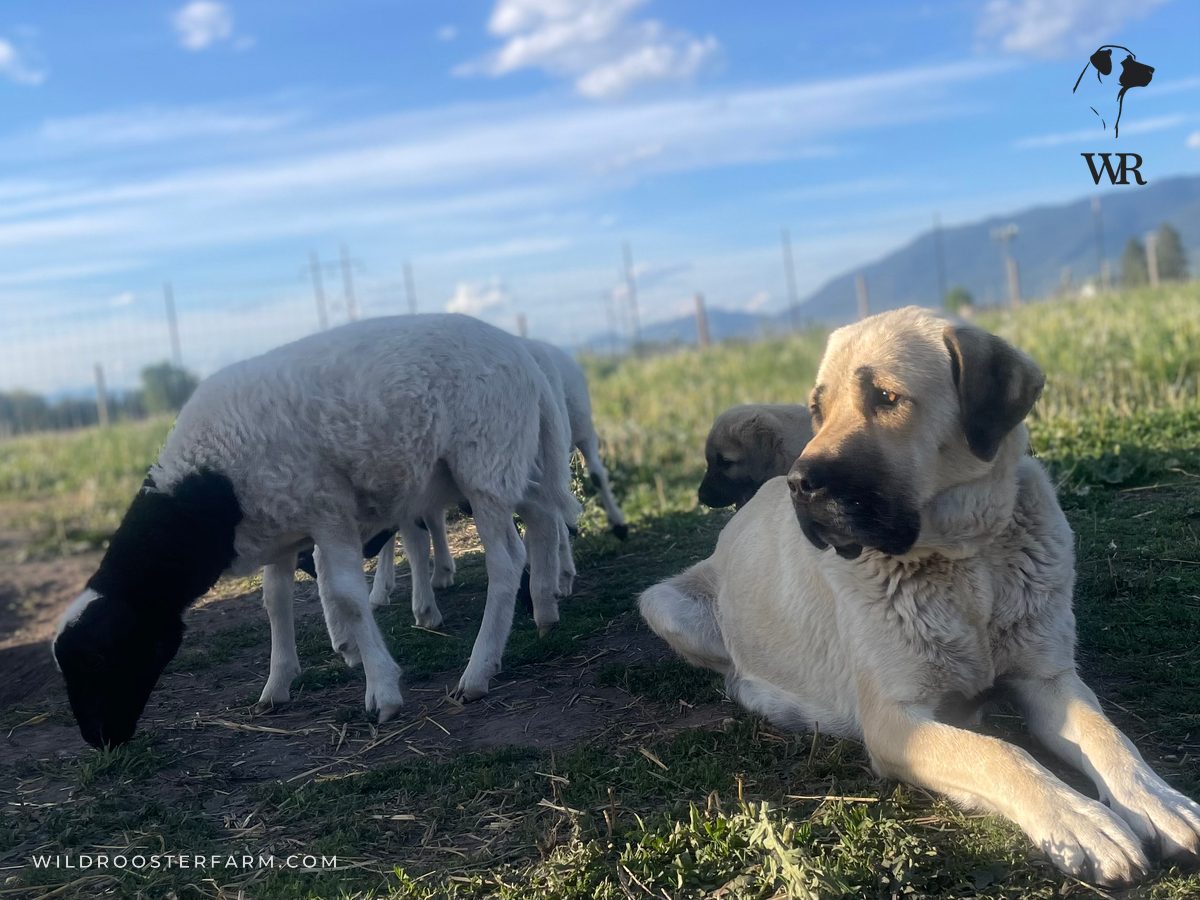
Both breeds have a double coat with a thick undercoat. The difference is the outer coat. The Great Pyrenees standard calls for a long, thick outer coat in white, or white with markings. The Anatolian standard allows a coat as short as one inch in any color. Ours are short-coated and fawn with black masks.
The coat matters most in heat. Texas A&M’s livestock guardian dog program notes that the Great Pyrenees is the most common guardian breed, in part because it is less aggressive toward people and livestock, and warns that its long coat ‘can pose a significant problem in Texas.’ It advises that long-haired guardians in warm climates need grooming to prevent matting and heat stress.
The same program reports that grass seeds and burrs catch in long coats in summer and can cause sores and infections if they are not brushed or trimmed out.
We found no evidence that either coat is better in cold. Our short-coated dogs work outside through Montana winters. The breed club says the coat needs little care except during seasonal shedding, when it calls for a thorough brushing. In our experience the shedding is just the undercoat and it is no big deal. We brush a dog when it needs it.
Anatolian Shepherd vs Great Pyrenees side by side
| Anatolian Shepherd | Great Pyrenees | |
|---|---|---|
| Male height | 29 inches and up | 27 to 32 inches |
| Male weight | 110 to 150 lb | About 100 lb at 27 inches |
| Female height | 27 inches and up | 25 to 29 inches |
| Female weight | 80 to 120 lb | About 85 lb at 25 inches |
| Coat | Short (about 1 inch) to rough (about 4 inches), thick undercoat | Long, thick double coat |
| Color | Any; ours are fawn with a black mask | White, or white with gray, badger, reddish brown or tan markings |
| Rated very effective (survey published in 1988) | 77% | 71% |
| Rated aggressive to predators | 96% | 95% |
| Rated aggressive to other dogs | 86% | 67% |
| Rated aggressive to sheep | 14% | 7% |
| Rated aggressive to people | 9% | 4% |
Will either one stop wolves or bears?
No single dog stops a wolf pack, and no honest breeder will promise that. Guardian dogs work by making a flock more trouble than it is worth, and in wolf country that takes several dogs, good fencing and people. What the research supports is narrower: a bolder, more canine-aggressive dog holds up better where predators are bigger. Our dogs guard our own sheep and hens in northwest Montana.
Which barks more?
We found no study that measured it. Both bark, because barking is how a guardian warns a predator off before it comes to a fight. Our male, Tucker, has a big bark and uses it. If barking is a problem where you live, neither breed is a good fit.
Which is better with chickens, sheep and goats?
Both guard all three when they are raised with them. The survey gives the Pyrenees the edge on gentleness: 7 percent of Great Pyrenees were rated aggressive to sheep, against 14 percent of Anatolians. A young Anatolian needs supervision with livestock until it matures. In a USDA evaluation of yearling dogs, 38 percent of 26 Anatolians rated good against 83 percent of 59 Great Pyrenees, mainly because of a higher tendency to injure or kill sheep. Our puppies grow up around hair sheep and laying hens with their parents showing them the job, and they still need an owner who will finish it.
Which should you choose?
The AKC standard describes the Great Pyrenees as ‘confident, gentle, and affectionate.’ The AKC describes the Anatolian as ‘protective and territorial.’ Both descriptions are fair.
If your threat is coyotes, you have close neighbors or regular visitors, and you want the more forgiving dog, the Great Pyrenees is a sound choice and we will tell you so.
If you have heavier predator pressure, a hot climate, room to work, strong fencing, and the experience or the patience to bring along a powerful, independent dog, the Anatolian is the step up. It asks more of its owner, and it gives more back.
The information on this page is general information about the breed, drawn from the sources listed and from our own experience. Individual dogs vary. Nothing here is a guarantee about the health, size, temperament or working ability of any particular puppy. The terms of any sale are those in our written contract.
Sources
- Ontario Ministry of Agriculture, “Livestock guardian dogs: selection and training” (Table 1)
- Green and Woodruff, “Livestock Guarding Dogs: Protecting Sheep from Predators,” USDA Agriculture Information Bulletin 588 (revised 1996)
- Green and Woodruff 1988, Journal of Range Management 41(3). Full citation: Green and Woodruff 1988. Breed comparisons and characteristics of use of livestock guarding dogs. Journal of Range Management 41(3): 249-251.
- Kinka and Young 2019, “Evaluating Domestic Sheep Survival with Different Breeds of Livestock Guardian Dogs”. Full citation: Kinka, D. and Young, J.K. 2019. Evaluating domestic sheep survival with different breeds of livestock guardian dogs. Rangeland Ecology and Management. https://doi.org/10.1016/j.rama.2019.07.002
- Kinka and Young 2018, “A Livestock Guardian Dog by Any Other Name”
- Young et al. 2019, “Spatial associations of livestock guardian dogs and domestic sheep”. Full citation: Young, J.K. et al. 2019. Spatial associations of livestock guardian dogs and domestic sheep. Human-Wildlife Interactions 13(1): 7-15.
- Texas A&M AgriLife, “Livestock Guardian Dogs: An Overview,” ANSC-PU-468, updated January 2026
- UKC Kangal Dog standard
- Agri-Pulse, March 12, 2014, “Got wolves? USDA brings on the big dogs”
- AKC Great Pyrenees standard
- AKC Anatolian Shepherd Dog standard
- Cat and Jim Urbigkit 2010, “Using dogs to help protect livestock from predators”
- Texas A&M AgriLife, “The Guardian Way,” August 2021
- Anatolian Shepherd Dog Club of America, Breed Facts at a Glance